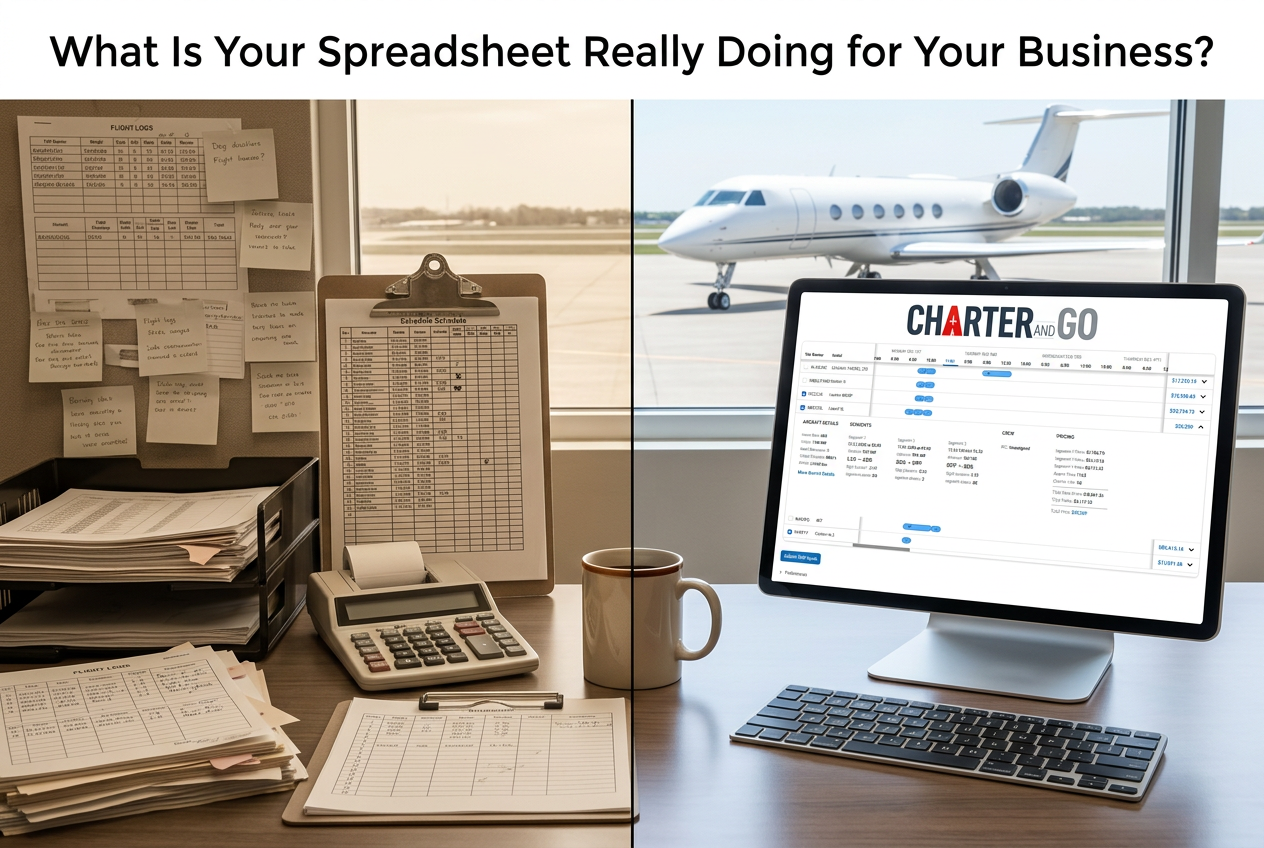
Taking the knowledge your team has built over years and putting it to work through connected aviation technology.
Every aviation business has knowledge that lives outside its software. It is in the spreadsheet and whiteboard a scheduler has refined over the years. The handwritten notes that explain a customer’s preferences. The pricing worksheet that accounts for the details a basic hourly rate misses. The checklist that helps an experienced employee keep a complicated trip moving. Those tools represent experience. They reflect lessons learned, problems solved, and processes developed by people who understand their operation. As the business grows, that knowledge needs to become easier to share, update, and apply. Going digital starts with a practical question: How do you carry everything your team knows into a system that makes their work easier?
What Is Your Spreadsheet Really Doing for Your Business?
A spreadsheet often begins as a simple solution to an immediate need. Over time, it becomes something much more valuable. A pricing workbook may capture customer agreements, aircraft costs, seasonal adjustments, and positioning assumptions. A scheduling sheet may reflect crew preferences, maintenance considerations, and the realities of a particular fleet. Before replacing it, understand it. Which decisions does it support? Who maintains it? What assumptions sit behind its formulas? Which exceptions require someone to explain what the numbers mean? Your answers reveal the requirements for a useful digital solution. Your spreadsheet can be a blueprint for improvement because it shows how your business actually works.
When Do Paper and Spreadsheets Start Creating More Work?
The limitations often appear between tasks. A customer changes the departure time. Someone updates the scheduling sheet, then emails dispatch, calls a crew member, revises the quote, and checks whether the customer record reflects the change. Each action may be manageable. Combined, they create a process that depends on everyone receiving, interpreting, and recording the same information. As activity increases, so do the questions:
-
- Which version is current?
- Has the change reached everyone who needs it?
- Was the revised cost included?
- Who owns the next step?
- Can another employee pick up the work without a lengthy explanation?
These are signs that your operation needs a more connected way to manage information.
So What Is the Difference Between Digitizing a Document and Improving a Workflow?
Scanning a paper form makes it easier to store. Moving a spreadsheet into shared online storage makes it easier to access. A stronger digital workflow also addresses what happens next. For example, consider a customer preference written in a trip folder, and a scanned copy preserves the note. A structured customer record makes that preference easier to find and use when preparing a future trip. The same principles apply to pricing. Uploading a worksheet preserves the calculation, however, translating its approved logic into configurable pricing rules can help the team apply that knowledge more consistently. The useful question is: Can the information support the next decision without someone having to find it and enter it again?
How Do You Preserve the Experience Behind the Process?
First, start with the people doing the work. Ask sales what they check before sending a proposal. Ask scheduling what makes an apparently simple trip difficult. Ask operations which details are most often missing. Ask finance where information needs to be corrected before an invoice can be completed. Include all the exceptions. A process may work smoothly for a straightforward trip but become difficult when a customer changes aircraft, adds a segment, or requests different arrangements. These conversations help distinguish between steps that protect the operation and steps that exist because the current tools require extra effort. The people closest to the work should help shape how that work becomes digital.
Where Should an Aviation Business Begin?
Choose one workflow with a clear source of friction with an outcome you can measure. For one operator, that may be moving customer information out of individual inboxes. For another, it may be reducing repeated entry between quoting and order management. A broker may begin by organizing customer requests, operator proposals, trip details, and follow-up in a consistent process.
A practical starting point looks like this:
| Current process | Digital objective |
| Customer preferences in notes and emails | A shared, structured customer record |
| Pricing knowledge in separate workbooks | Approved, repeatable pricing rules |
| Trip changes communicated through multiple messages | A current record with clear update responsibilities |
| Follow-up tracked on personal lists | Visible ownership and next steps |
| Reports assembled manually from several sources | More consistent access to business information |
Begin with a manageable scope. Validate the information, train the team, and test the workflow against real situations before expanding.
How Do You Know Whether Going Digital Is Helping?
Look at the work your team can complete with greater clarity and less effort. Can employees find the current trip details more easily? Are they entering the same information fewer times? Can another team member continue a customer conversation? Are pricing decisions easier to explain? Does management have better visibility into outstanding work? Measure the starting point and compare it with the new process. Useful measures may include time spent preparing a quote, repeated data entry, corrections, outstanding follow-ups, and the effort required to produce a report. Listen to employees as well. A system may appear efficient in a demonstration while adding unnecessary steps during a busy day. Digital improvement requires ongoing evaluation as the operation changes.
Why Charter and Go Is Taking a Different Approach
At Charter and Go, we believe aviation software should reflect the realities of the businesses using it. That starts with listening to the people behind the operation and understanding the experience built into their existing tools. Our approach centers on connected workflows that bring customer relationships, quoting, pricing, order management, and aviation operations into a more coordinated working environment. The objective is practical: help teams access the information they need, reduce repetitive work, and carry their knowledge forward as the business grows. A successful transition makes employees’ experience more useful across the organization.
The Bottom Line
Your paper files and spreadsheets tell a story about how your business learned to operate. They hold valuable knowledge. The next step is to make that knowledge easier to use, share, and build upon. Start with the experience your team already has. Identify where information gets delayed or repeated. Then create digital workflows that help people do their jobs with greater confidence.
Take what you know. Connect how you work. Build what comes next.
Charter and Go
Connected technology. Built for real aviation operations.
www.charterandgo.com