
How Intelligent, Action-Driven Technology Is Changing the Way Charter Operators, Brokers, and Regional Airlines Manage Their Businesses
Executive Summary
For years, aviation technology has focused on automating individual tasks. Software can generate quotes, schedule aircraft, manage customer information, calculate trip costs, and track operational requirements. These capabilities have helped aviation companies become more efficient. However, traditional automation often depends on predefined instructions and employees moving information between systems. Now, a new generation of artificial intelligence is beginning to change that approach. It is called Agentic AI, and its significance extends well beyond generating content, answering questions, or automating individual tasks. Agentic AI can work toward a defined objective, evaluate information, determine the next steps, interact with connected systems, and execute authorized actions with varying levels of human supervision. 1
For the charter aviation industry, this represents an important shift in how technology can support business operations.
At Charter and Go, we believe the future of aviation technology isn’t simply about helping employees complete tasks faster. It’s about connecting information, automating workflows, and giving aviation professionals the tools to make more intelligent business decisions. The question is no longer just what aviation software can do. It’s what aviation software can help your business accomplish.
What Is Agentic AI in Charter Aviation?
Agentic AI refers to artificial intelligence systems designed to pursue specific goals by interpreting information, planning actions, and using connected tools to complete a sequence of tasks. Consider a typical charter request. A customer sends an email requesting a flight from Dallas to Miami for six passengers next Thursday. In a traditional environment, a salesperson may need to review the email, enter the request into a CRM, search for suitable aircraft, check pricing, prepare a quote, and follow up with the customer. With properly configured agentic AI, the system could potentially coordinate much of that process. It could interpret the request, identify missing information, initiate an authorized customer follow-up, retrieve relevant aircraft and pricing information, and prepare a proposed quote for review. Instead of waiting for an employee to initiate each individual step, the technology can coordinate multiple actions toward the goal of preparing an accurate charter proposal. This distinction is fundamental.
Traditional automation completes predefined tasks. Agentic AI can coordinate tasks, evaluate changing information, and determine what authorized action should happen next. The result is an opportunity to transform disconnected activities into more intelligent, connected workflows.
How Is Agentic AI Different from Traditional Automation?
Traditional automation remains an important part of aviation technology. It is particularly effective when processes follow clear, predictable rules. For example, a system can automatically send a confirmation email when an order reaches a designated status. But what happens when the customer submits an incomplete request, the preferred aircraft becomes unavailable, or the original pricing information changes? Traditional automation generally requires additional rules, manual intervention, or a separate workflow. Agentic AI can offer greater flexibility by interpreting circumstances and choosing among permitted actions. 2
| Traditional automation | Agentic AI |
| Follows predefined steps | Works toward defined objectives |
| Uses established rules | Can evaluate context and select actions |
| Handles predictable workflows | Can adapt to variable information |
| Often requires manual intervention for exceptions | Can identify and respond to some exceptions |
| Automates individual tasks | Can coordinate multistep processes |
| Executes programmed actions | Uses tools within authorized boundaries |
This does not mean agentic AI replaces traditional software logic. In aviation, reliable rules and validated calculations remain essential, particularly for pricing accuracy, crew legality, aircraft limitations, regulatory requirements, and financial controls. The opportunity is to combine proven aviation software with intelligent workflow coordination.
How Can Agentic AI Transform Air Charter Quoting?
Speed has always been important in charter sales. Customers often request quotes from multiple brokers or operators, and the company that responds quickly with a credible proposal may gain an advantage. But fast quoting requires more than simply calculating a price. The system must account for aircraft suitability, trip requirements, availability, positioning, operating costs, customer preferences, and business objectives. Agentic AI can potentially connect these activities into a coordinated workflow.
Illustrative agentic charter quoting workflow
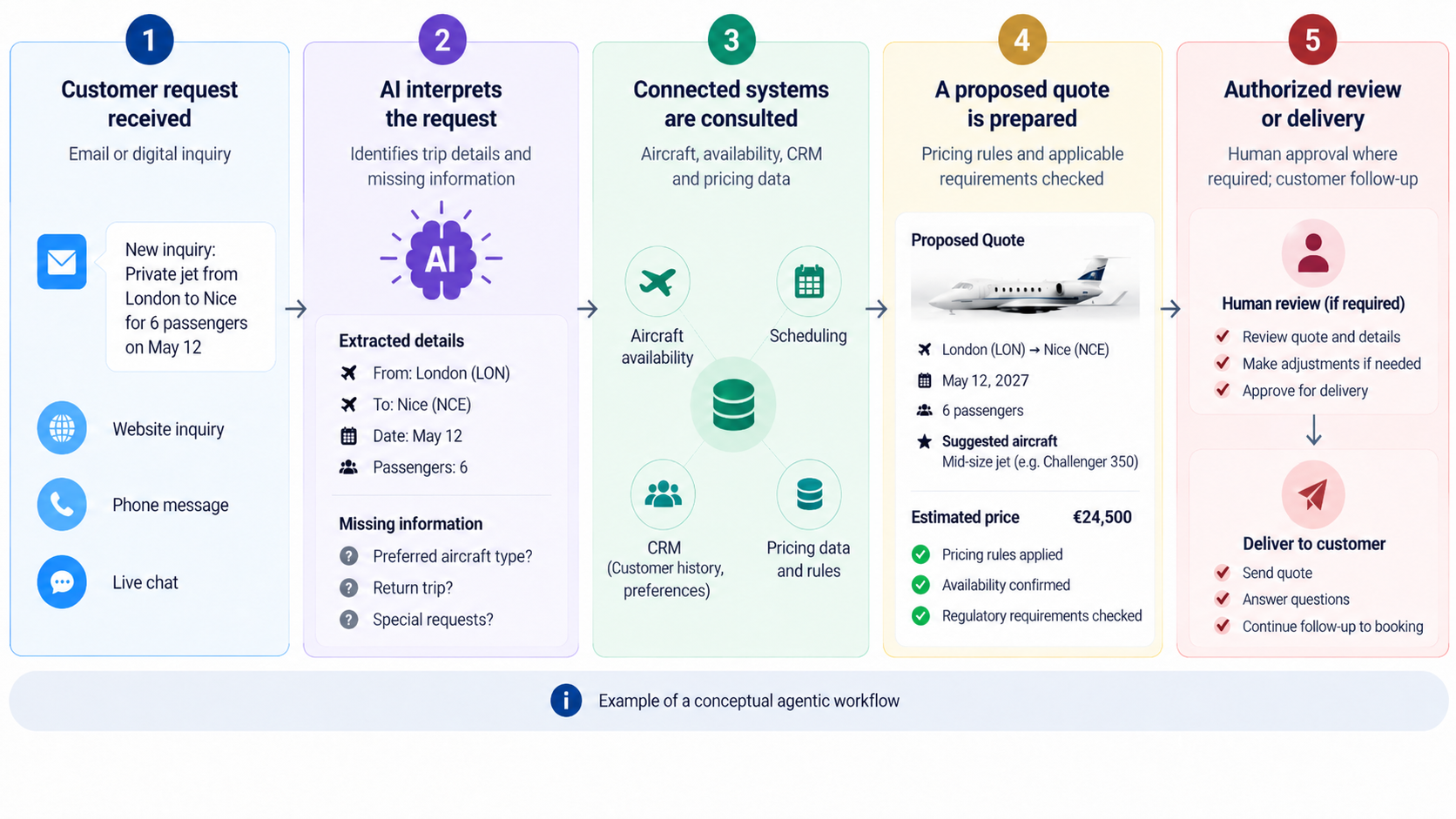
At Charter and Go, ConnieAI reflects our commitment to bringing aviation-specific intelligence into the quoting process. Our broader technology direction is to connect intelligent request processing with CRM, aircraft sourcing, pricing, and order management. The objective is not to eliminate the salesperson. It is to eliminate unnecessary work that keeps the salesperson from selling.
Can Agentic AI Improve Revenue Management and Charter Profitability?
Every charter quote represents a commercial decision. Winning a flight at the wrong price may generate revenue without delivering the profitability the company needs. Agentic AI, when combined with revenue management technology, could help operators and brokers evaluate several factors before presenting a proposed price. These include aircraft operating costs, positioning requirements, market demand, customer history, utilization opportunities, and target margins.
For example, if a requested aircraft is poorly positioned for a particular trip, an intelligent workflow could evaluate other suitable aircraft or flag a more economical option. If a pricing proposal falls below an established margin threshold, the system could identify the exception and route it for approval. This is where intelligent workflow coordination becomes valuable. Rather than treating quoting, sourcing, and profitability as separate activities, the technology can help connect them.
At Charter and Go, our revenue management philosophy is centered on helping operators and brokers make informed commercial decisions using relevant business information. Speed Wins. Intelligence Protects. That principle becomes even more important as aviation businesses adopt advanced automation. The fastest quote is not necessarily the best quote. The objective is to respond quickly while protecting the economics of the transaction.
How Can Agentic AI Improve Aircraft and Crew Management?
Aircraft scheduling and crew management involve multiple interconnected considerations. A change in one flight may affect aircraft positioning, crew availability, maintenance schedules, customer commitments, and future bookings. Traditional systems can identify many of these relationships through business rules and scheduling logic. Agentic AI could extend these capabilities by coordinating information across systems and helping teams evaluate possible responses.
For example, if an aircraft becomes unavailable, an agentic workflow might identify affected trips, retrieve suitable alternatives, check available crew information, and prepare revised options for dispatch personnel. The critical distinction is that the technology supports the decision-making process without independently assuming responsibility for operational control or safety-critical approvals. The FAA’s approach to aviation AI emphasizes safety assurance, evaluation of system performance, and appropriate integration into aviation’s regulatory framework. 3
At Charter and Go, we believe this distinction is essential. AI should help aviation professionals identify problems earlier, evaluate options faster, and maintain better operational visibility—while keeping qualified personnel in control.
What Role Does Agentic AI Play in Customer Relationship Management?
Customer relationships are central to private aviation. A charter customer may have preferred aircraft, familiar destinations, special service requirements, or a history of traveling during specific periods. Traditional CRM technology stores and organizes much of this information. Agentic AI could help transform that information into timely, authorized action.
For example, an intelligent customer management workflow might recognize that a frequent charter client has not booked in several months, identify relevant previous travel patterns, and prepare a personalized follow-up recommendation for the sales team. It could also help coordinate communications after a completed flight, identify unresolved customer requests, or support loyalty program engagement. These capabilities could be particularly valuable to brokers and operators looking to improve customer retention without adding repetitive administrative work.
Charter and Go’s vision is to connect customer intelligence with the larger commercial environment, including CRM, quoting, loyalty programs, and order management. The future of customer relationship management isn’t simply knowing more about the customer. It’s using that information responsibly to deliver better service.
Why Are Open APIs Essential for Agentic AI in Aviation?
An AI system is only as useful as the information and capabilities it can access. Charter aviation businesses rely on specialized systems for aircraft sourcing, scheduling, maintenance, accounting, customer management, fuel, payments, and operational coordination. If these systems cannot exchange reliable information, the AI may be limited to answering questions rather than helping complete meaningful business workflows. This is why connected architecture matters. Open APIs can allow appropriately authorized AI systems to retrieve data and interact with external applications. Agentic AI architecture commonly relies on access to tools, APIs, and structured data sources to carry out multistep tasks.4 5 6
For Charter and Go, open APIs are not an afterthought. They are part of our vision for connected aviation technology. We believe operators and brokers should be able to use the tools that work best for their businesses while keeping information connected across the organization. Agentic AI cannot deliver its full business value when critical information remains trapped in disconnected systems.
Will Agentic AI Replace Aviation Professionals?
As agentic AI becomes more capable, one concern naturally emerges: Will this technology replace sales teams, charter brokers, dispatchers, and operations professionals? At Charter and Go, we view the opportunity differently. Aviation depends on experience, accountability, relationships, and professional judgment. AI can help process information, organize workflows, identify exceptions, and support timely decisions.
Technology should not remove the human accountability required to operate an aviation business safely and responsibly. This is particularly important when decisions involve operational control, regulatory requirements, financial commitments, customer trust, or safety. Agentic AI systems should therefore operate within clearly established permissions, validation procedures, escalation rules, and approval requirements.
At Charter and Go, our philosophy is straightforward: We believe AI should empower aviation professionals, not replace their expertise. By automating routine tasks, connecting critical information, and providing real-time business intelligence, AI allows teams to focus on what matters most—making informed decisions, delivering exceptional customer service, and operating safely and efficiently.
Technology should strengthen human decision-making while keeping aviation professionals in control of their operations and accountable for the decisions that matter.
How Should Aviation Companies Prepare for Agentic AI?
Adopting agentic AI requires more than purchasing an AI application. Operators, brokers, and regional airlines should first evaluate how information moves throughout their businesses. Are customer records connected to quoting? Does pricing reflect relevant business information? Can employees see the status of an order without searching multiple applications? Are operational changes communicated efficiently? Can different systems exchange reliable information? These questions are essential because intelligent agents depend on accurate data, defined workflows, and controlled access to business systems.
Companies should also establish clear boundaries for what AI can recommend, what it can execute automatically, and what requires human authorization. A practical approach starts with lower-risk administrative and commercial processes, measures the results, and expands as reliability and controls are demonstrated. The companies best prepared for agentic AI will be those that first establish reliable, connected business processes.
Why Charter and Go Is Building Toward Intelligent Aviation Business Management
At Charter and Go, we have always believed aviation software should do more than manage flights. Operators and brokers need technology that helps them manage their entire businesses—from customer acquisition and pricing to flight coordination, revenue optimization, and customer retention. That vision is why we continue investing in connected systems, automation, and aviation-specific artificial intelligence. ConnieAI, our quoting capabilities, CRM, ONE Order management, revenue management technology, and open API architecture represent important elements of that broader strategy.
We see agentic AI as an opportunity to bring these capabilities closer together, allowing information to move more intelligently through business processes and giving professionals greater visibility into what needs attention. Our objective is not automation for its own sake. It is to help aviation companies reduce unnecessary work, improve commercial performance, enhance customer experiences, and operate with greater confidence. As these technologies evolve, our focus remains on practical aviation applications rather than technology that simply sounds impressive. We believe the next generation of aviation software will be measured by how effectively it helps businesses make decisions, manage resources, and improve outcomes.
The Bottom Line: From Software That Follows Instructions to Software That Helps Move the Business Forward
Traditional automation helped aviation companies reduce repetitive tasks. Artificial intelligence introduced new ways to interpret information, recognize patterns, and support decision-making. Agentic AI represents another step: technology capable of coordinating multiple actions toward a business objective, within defined operational and commercial boundaries. For charter operators, brokers, and regional airlines, the implications could be significant. Faster quoting. Better information. Smarter commercial decisions. Improved operational coordination. More personalized customer experiences. Greater business visibility. The real opportunity is not to remove aviation professionals from the process. It is to give them technology that handles more of the routine work while helping them focus on decisions that require human expertise.
At Charter and Go, we believe the future of aviation technology is moving beyond managing individual transactions toward optimizing the entire business. The next competitive advantage in aviation won’t simply be having more technology. It will be having technology that works more intelligently for your business. And that is the future Charter and Go is building toward.
Charter and Go — Aviation Software Built for Operators and Brokers. Speed Wins. Intelligence Protects.