
The Private Charter Industry Is Ready for Its Booking.com Moment
Why Private Aviation’s Next Transformation Will Be About Real-Time Availability, Intelligent Pricing, Trust, and Connected Technology
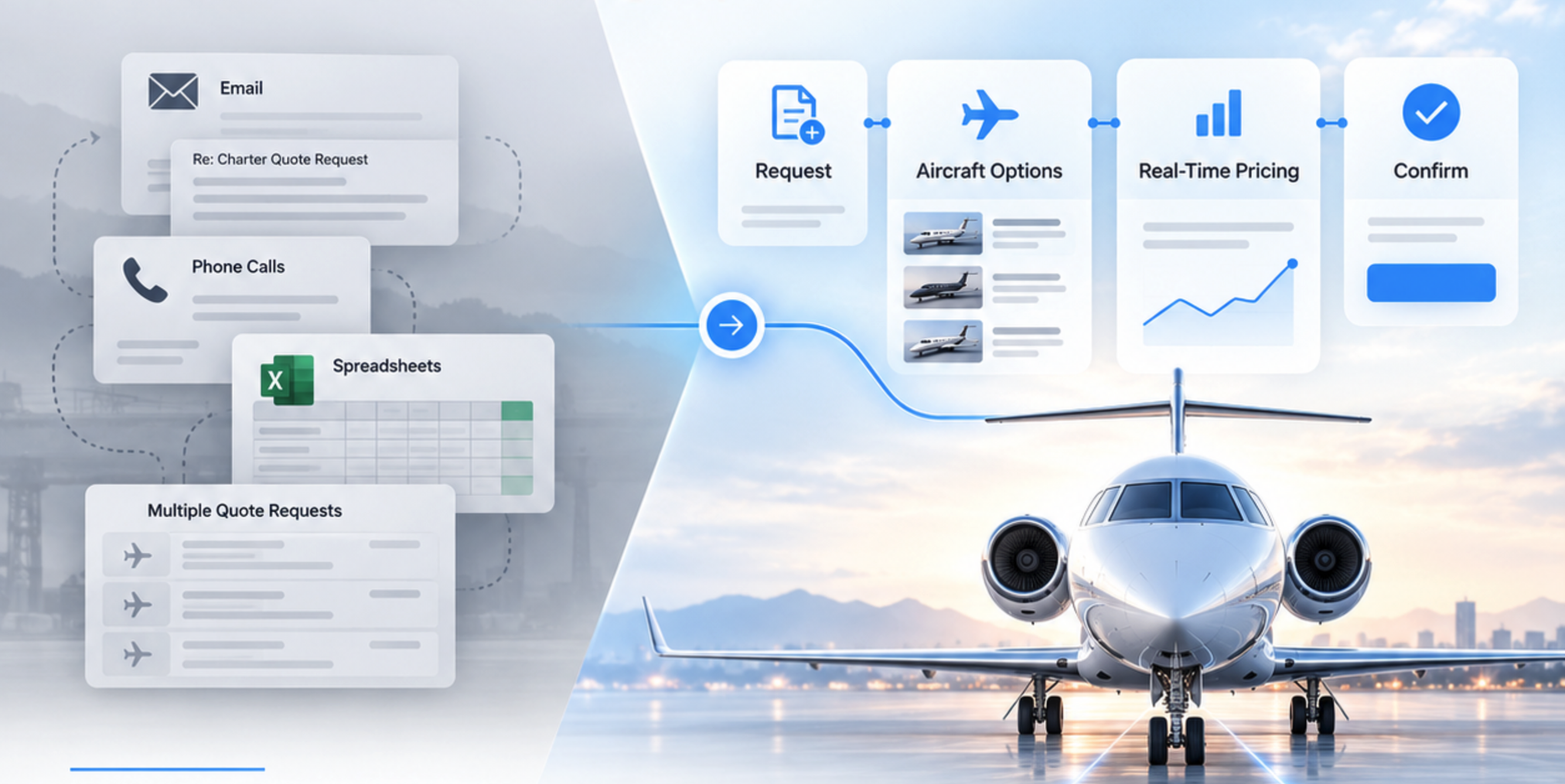
Travel has changed dramatically over the past two decades. A traveler can open an app and see hotel availability around the world. They can compare rates, amenities, reviews, and locations before making a reservation. They can search airline schedules and fares in seconds. They can request transportation and watch a vehicle approach in real time. Consumers have become accustomed to technology removing friction from complicated transactions.
Yet booking a private aircraft can still require emails, telephone calls, spreadsheets, manual availability checks, quote revisions, and multiple conversations before a customer knows what aircraft is actually available and what the trip will cost.
For an industry built around convenience, speed, and exceptional customer experience, that disconnect is becoming increasingly difficult to ignore. The private charter industry may be approaching its Booking.com moment. Not because private aircraft should be sold exactly like hotel rooms. They should not. Private aviation is significantly more operationally complex. But the expectation behind the comparison is becoming increasingly relevant: Why should finding and purchasing private aviation still be difficult when technology can connect operators, aircraft, pricing, and customers in real time?
The Market Is Beginning to Ask the Same Question
In September 2026, private aviation marketplace Jettly publicly called on U.S. Part 135 operators to provide three things that have historically been difficult to obtain consistently across the charter marketplace:
- Live aircraft availability
- Upfront all-in pricing
- Published safety and insurance credentials
The argument is straightforward. Other travel industries have dramatically reduced the friction between a customer expressing intent and completing a purchase. Private aviation still relies heavily on relationships, telephone calls, emails, spreadsheets, and manual quoting. Those relationships remain extremely important. But relationships and technology do not have to compete. The better question is how technology can make those relationships stronger.
The Problem Is Not the Lack of a Booking Button
It would be easy to look at this challenge and conclude that private aviation simply needs better online booking. That misses the larger issue. Putting a Book Now button on a website does not create real-time private aviation booking. Before a customer can confidently book an aircraft, the technology behind that button has to answer some very complicated questions:
- Is the aircraft actually available?
- Is it the right aircraft for the specific mission?
- Can it operate into the requested airports?
- Does it have the range and performance required?
- Where is the aircraft currently positioned?
- What will it cost to land at those airports?
- Are qualified crew available?
- Are those crew members legal for the mission?
- Are there maintenance requirements that affect availability?
- Are there owner restrictions?
- What are the airport limitations?
- What does the trip actually cost the operator?
- What margin should be protected?
- Is demand increasing?
- Could accepting this trip negatively affect a more valuable future opportunity?
Only after those questions are answered does an aircraft become truly bookable inventory. That is why private aviation’s transformation cannot begin at the website. It has to begin inside the operation.
Live Availability Must Mean More Than an Open Calendar
One of the biggest opportunities in private charter is live aircraft availability. But availability in aviation is not binary. An aircraft can appear open on a schedule and still be unavailable for a specific mission. The aircraft may not have the required performance. The crew may not be legal. Maintenance may be approaching. The aircraft may be positioned in a location that makes the trip economically unattractive. An owner may require access to the aircraft. Airport restrictions may make another fleet type more appropriate. A true live-availability engine must understand these variables. It cannot simply ask: Is this aircraft scheduled? It needs to ask: Can this aircraft safely, operationally, and economically perform this mission? That is a much more sophisticated definition of availability. And it is where intelligent aviation technology becomes essential.
Customers Want Pricing Earlier
Pricing presents the same challenge. Customers increasingly expect to understand what something will cost before beginning a lengthy sales conversation. But charter pricing is inherently dynamic. The same aircraft flying the same route can have very different economics depending on the date, aircraft position, demand, utilization, crew requirements, fuel, airport expenses, seasonality, special events, and what happens to the aircraft after the trip. That is why simply publishing a fixed hourly rate does not solve the problem.
Modern charter operators need the ability to calculate pricing dynamically. The technology should understand the underlying cost of the mission and allow the operator to apply its own commercial strategy. Real-time pricing should not mean giving away control of pricing. It should mean giving operators better technology to exercise that control.
Transparency Does Not Mean Commoditization
Some operators may understandably be concerned that greater pricing transparency could turn private aviation into a commodity. That does not have to happen. Hotels have different brands. Airlines have different products. Luxury businesses differentiate themselves through experience, reliability, quality, reputation, and service even when pricing is visible. Private aviation can do the same.
- Aircraft quality matters
- Safety matters
- Service matters
- Reliability matters
- Customer support matters
- Operational capability matters
Transparency simply gives customers better information with which to evaluate those differences. The opportunity is not to turn every Gulfstream, Citation, Challenger, or Learjet into an interchangeable product. The opportunity is to remove unnecessary friction from the buying process while preserving the qualities that make each operator different.
Trust Has to Become Part of the Digital Experience
Private aviation customers are buying something far more consequential than a hotel room. Safety and operational credibility matter. That means the next generation of charter purchasing must combine convenience with trust. Customers should be able to understand who is operating the aircraft. They should be able to understand relevant safety credentials. They should understand what they are purchasing and who is responsible for operating the flight.
The digital experience should make important information easier to understand, not hide complexity behind a polished interface. The industry’s Booking.com moment cannot simply be about speed. It has to combine: Speed. Transparency. Operational integrity. Trust.
The Aircraft Recommendation Must Become Intelligent
Customers do not always know which aircraft they need. They know where they want to go, when they need to arrive. They know how many people are traveling and what experience they want. Technology should be able to help with the rest.
Aircraft recommendation technology can evaluate the mission and identify suitable options based on a list of characteristics. Instead of making the customer understand the fleet, technology can help translate the customer’s needs into appropriate aircraft choices. That makes the purchasing experience easier while still preserving operator control.
The Operator Must Remain in Control
There is another important part of this transformation. Digitization should not require operators to surrender control of their products, customers, pricing, or data. Operators create the capacity, they operate the aircraft, they employ the crews, they manage safety, they maintain the aircraft, they carry the operational responsibility. Technology should therefore help operators distribute their product more effectively while allowing them to maintain control over how that product is priced and sold.
This is why open APIs are becoming so important. An operator should be able to connect its availability and pricing to marketplaces, brokers, direct customers, corporate clients, and other distribution channels without managing separate versions of the truth. The operator’s system should become the intelligent source behind those channels.
The Real Opportunity Is Direct and Marketplace Distribution
Marketplaces will remain an important part of private aviation. Brokers will remain important. Direct sales will remain important. Corporate relationships will remain important. The future does not have to belong exclusively to one distribution model. Connected operators should be able to participate in all of them.
An operator could expose appropriate inventory to a marketplace while simultaneously offering availability through its own website. A preferred corporate customer could receive negotiated pricing. A broker could request availability electronically. A direct customer could interact with an AI assistant. A salesperson could still personally manage a high-value relationship. The technology should support all of those paths while connecting them back to the same operational environment. That is not replacing relationships. It is giving those relationships better infrastructure.
Faster Does Not Have to Mean Less Personal
Private aviation is a relationship business. That is unlikely to change. Customers often want to speak with someone who understands their needs. Complex trips require experience. Irregular operations require judgment. High-value customers expect personal attention. Technology should not remove those strengths. It should remove the work surrounding them that does not require human expertise.
A salesperson should not spend 20 minutes copying information from an email when AI can identify the trip. An operator should not need three telephone calls to determine basic aircraft availability when its systems already contain the information. A customer should not have to wait hours to receive acknowledgement of a request. Employees should spend their time on the parts of private aviation where people provide the greatest value.
- Relationships
- Judgment
- Problem solving
- Service
- Safety.
This Is Bigger Than Online Booking
Private aviation’s Booking.com moment will not be defined by a single website. It will not belong to one marketplace. And it will not happen because someone creates a better booking screen. It will happen when the infrastructure underneath private aviation becomes connected enough to support a genuinely modern buying experience.
Complexity Should Live Behind the Screen
This may be the most important principle of all. Private aviation is complex. It should remain rigorous. Safety cannot be simplified away. Operational requirements cannot be ignored. Crew legality cannot be bypassed. Aircraft performance cannot be assumed. Maintenance cannot be treated as a calendar inconvenience. But the customer should not have to manage that complexity. The technology should.
The systems behind the transaction should evaluate the complexity and present customers and employees with clear, actionable choices. That is how other industries transformed their digital experiences. They did not eliminate complexity. They moved it behind the screen.
The Private Charter Industry Is Ready
Private aviation does not need to become the hotel industry. It does not need to become commercial aviation. And it certainly does not need to sacrifice the personal service that makes charter unique.
At Charter and Go, we believe the next generation of charter technology should connect the entire commercial and operational journey—from the first customer request to aircraft recommendation, availability, pricing, order management, operations, payment, and business intelligence.
AI can accelerate that journey. Open APIs can connect it. Revenue management can optimize it. ONE Order can organize it. And experienced aviation professionals can remain firmly in control of it. The question is no longer whether private aviation will become more digital. It already is. The more important question is: Who will build the connected infrastructure that allows private aviation to deliver the speed customers expect without sacrificing the operational intelligence, safety, service, and trust the industry requires?
Private aviation is ready for its Booking.com moment. But the real breakthrough will not be the booking button, It will be everything intelligent happening behind it.